
Moral Conviction is Not Criminal Intent’ – Golden Gate Bridge Protestors Claim Victory in Court Ruling
- 4 hours ago
- 5 min read

SAN FRANCISCO — Seven Bay Area activists on trial for a pro-Palestine demonstration in 2024 that blocked the Golden Gate Bridge for four hours were found guilty of multiple misdemeanor charges on Thursday, July 2.
The jury was hung on the most serious charge, felony conspiracy, prompting the defendants to declare a welcome, if partial victory.
“Today remains a victory,” said public defender Noha Abusamra at a press conference after the verdict on the steps of City Hall. “We do not fight solely to win. We fight to fight,” she said, referencing the ongoing defense of Palestinians in the face of continued Israeli aggression.
The issue was central to the defense in the case, which hinged on the question of intent.
Attorneys for the defendants argued their motivating factor in carrying out the protest was the protection of life, in this case Palestinians who have experienced what human rights groups, international bodies and a growing number of countries say is a genocide.
More than 73,000 Palestinians have been killed since Israel’s assault on Gaza following the Oct. 7, 2023 attacks by Hamas, which resulted in some 1,200 deaths, including more than 800 civilians. Many Palestinians continue to face extreme hunger and privation.
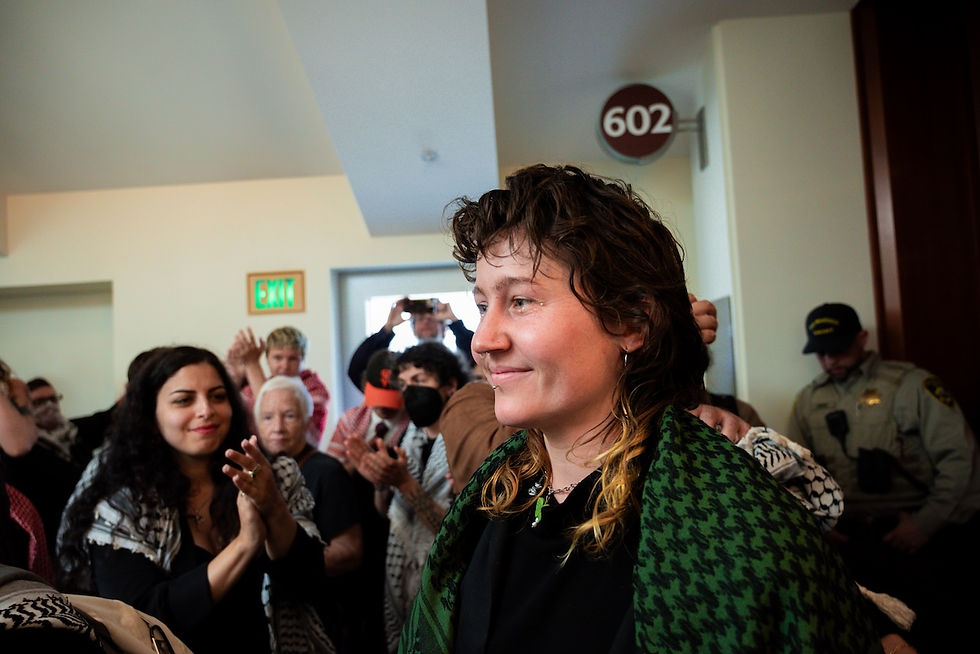
River Allen, one of seven defendants in the case, leaves the courtroom Thursday after hearing the verdict. (Credit Peter Schurmann)
In bringing the felony conspiracy charge, San Francisco District Attorney Brooke Jenkins argued the protestor’s actions threatened public safety. The day after the protest she issued a public call to “anyone who was falsely imprisoned on the Golden Gate Bridge,” promising restitution.
Critics, including some legal experts, have criticized the DA’s approach as “a classic overprosecution of an act of civil disobedience,” warning that it would have a chilling effect on public dissent.
Attorney Katherine Isa, who represented one of the defendants in the case, Conrad de Jesus, accused the DA’s office of anti-Palestinian bias.
“This is the first time they have sought felony charges, conspiracy charges against a group of individuals protesting in this manner,” she said during Thursday’s press conference. “We’ve had protests on the Bay Bridge that have also blocked it for four hours. We’ve had protests throughout history on the Golden Gate Bridge. None of which were prosecuted in this way.”
Defendants had sought to force Jenkins to recuse herself from the case, citing meetings she’d held with officials from the Israeli consulate in 2023 and past remarks describing anti-war protestors as “pro-Hamas.”
Jenkins said Thursday after the ruling her office would “consider next steps,” amid concerns she could opt to retry the case.

Rocky Chau hugs supporters outside the San Francisco Superior Courtroom Thursday, July 2. (Credit Peter Schurmann)
The jury remained narrowly split on the felony charge with 10 jurors having voted guilty. On the misdemeanor count of trespassing to interfere with a business, 11 jurors voted not guilty, with one holdout. Judge Teresa Caffese declared a mistrial on both charges.
The defendants, Sarah Ferrell, Conrad de Jesus, Em Tillotson, Bhavika Anandpura, Rocky Chau, Sara Cantor, and River Allen, were convicted of four misdemeanor counts of false imprisonment, and one count each of obstruction of a thoroughfare and unlawful assembly. Cantor was also found guilty of one count of refusal to disperse from a riot.
They faced prison terms of up to 15 years had they been convicted of the felonies. Public defender Anthony Gedeon said at the press conference that the verdicts could mean a maximum of five years in prison for each. Cantor faces potentially five and a half years.
The defense team says they will appeal the guilty verdicts.
“This case will be remembered in history,” said Abusamra. “It is precedent for the movement. It is precedent for all lawyers. It is precedent for our human rights in America.”
Dozens of supporters packed the courthouse Thursday, most draped in keffiyehs, the traditional checkered scarf and now ubiquitous symbol of Palestinian solidarity.
As the foreman read the guilty verdicts, some began crying silently. Misty eyes scanned the room for comfort. Abusamra could be seen weeping next to colleague Gedeon, who held his head in apparent disbelief. Defendant Anandpura was mouthing what appeared to be “it’ll all be ok” to someone in the audience.
Judge Caffese then began to thank the jury for its dedication to the case, and remarking on the efficacy of the court system. The crowd audibly scoffed at this and began drowning out the judge with coughs. When Judge Caffese ordered the courtroom cleared of everyone except the media and attorneys, the noise turned into jeers, with calls of “Shame!” and “The justice system does not work!” Some yelled at the jury directly, saying, “You should all be ashamed of yourselves.”
As the judge made her final remarks to the jury, protest chants reverberated in the hallway outside the courtroom. Ananpura addressed the crowd later.
Defense attorney Shaffy Moeel addresses a crowd on the steps of San Francisco City Hall on

Thursday, July 2. Behind her are defendants Conrad de Jesus, River Allen and Bhavika Anandpura. (Credit: Peter Schurmann)
“You know when we stopped that bridge, we did not think that we alone would stop the genocide. But we weren’t alone then. We’re not alone now.”
In the April 15, 2024 protest, activists demonstrating against U.S. support for Israel drove southbound onto the Golden Gate Bridge at around 8 am and stopped their cars in all lanes. Traffic was halted for around four hours. The protest was part of a nationwide day of action in coordination with other major cities.
Jenkins said at the time that the demonstration caused “extreme threats to the health and welfare of those trapped” on the bridge. In August 2024, her office filed charges against 26 members of the protest, including 8 with felonies. One of those felony cases was dropped, while 18 others with misdemeanors were diverted or dismissed.
“Whatever you think of the protest method, the jury decided that the criminal law was the wrong tool to use against them in finding that the government did not prove beyond a reasonable doubt a conspiracy charge,” said defense attorney Shaffy Moeel.
“Moral conviction is not criminal intent,” she added.
The jury began deliberating on June 5, nearly 2 years after the action in question. The jury was tasked with deciding whether the state had proven beyond a reasonable doubt that the protestors were guilty of the 57 charges brought against them. These charges are reduced from the original 1,144 charges filed in August 2024.
“We don’t ask you to agree with what our clients did on April 15th, 2024. We never did,” said Moeel. “We asked 12 people to determine whether the prosecution proved criminal intent beyond a reasonable doubt. The answer was no. They could not prove it. And that is what justice looks like. That is what we are fighting to protect in this courthouse and everywhere.”
The seven defendants will be sentenced on August 21.
Peter Schurmann contributed reporting for this story


Comments