
Crossing the Line — In Texas, an Improper Lane Change Could Spell Deportation
- Mar 12
- 6 min read
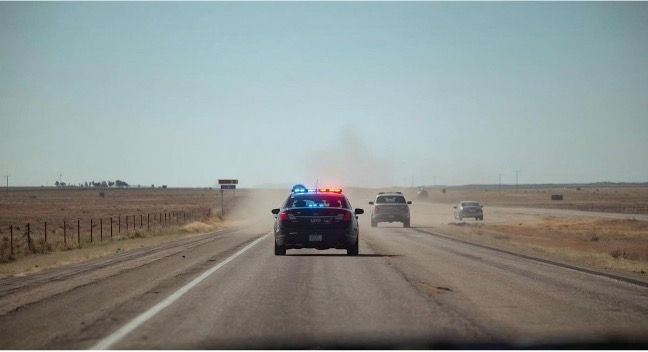
Last summer, Omar Salazar, a young entrepreneur living in Dallas, TX, went to visit his girlfriend, Ella, in Lubbock, up in the Texas Panhandle. Driving Ella to class, maybe distracted by conversation, maybe in a hurry to get her there on time, while exiting the freeway, he crossed a solid white line lane divider. A traffic cop pulled him over for an improper lane change.
Crossing over the white line cost Salazar six months in ICE detention and will most probably result in his being deported back to Mexico. The consequences extend beyond Salazar. Ella, now his wife, was forced to drop out of law school, while a booming U.S. industry is losing a young businessman working hard to put AI to innovative, practical use.
Salazar’s story is one of bad luck and ill timing—ordinary moments colliding with a system of anti-immigrant enforcement unraveling a young man’s promising life and career.
Crossing over the line in Lubbock was the 3rd strike in a series of random events in Salazar’s life which brought him to the place he is now: the Bluebonnet ICE Detention Center.
1st Strike: Brought to the U.S. at the Wrong Time
Salazar’s parents brought him to the U.S. from Mexico in 2008 when he was 11 years old. Living up to his parents’ dreams and expectations, he graduated as valedictorian of his Dallas high school class, went on to Southern Methodist University, and then to working in the emerging field of Artificial Intelligence. Yet he still found time to volunteer and worked tirelessly as a civic activist and advocate for immigrants’ rights.

Salazar isn’t a Dreamer. When DACA was announced, he had been in the United States for four years. But in order to qualify, applicants had to have lived in the U.S. for 5 years. The 5-year residency requirement stemmed from the insistence that Dreamers be “deeply rooted” in American culture to qualify. That one-year gap left him classified as an unauthorized immigrant, ineligible for the protections that Dreamers have. As President Obama said about Dreamers, “They are Americans in their heart, in their minds, in every single way but one: on paper.”
Salazar epitomizes an all-American success story, but without that paper documentation.
2nd Strike: Driving in Texas
Texas is more anti-immigrant than other states, yet there are about 2 million immigrants without legal status living in the state.
In 1996, Section 287(g) of the Immigration and Nationality Act was enacted, authorizing ICE to delegate certain federal immigration enforcement functions to state and local law enforcement agencies. This essentially allows local law enforcement to serve as a supplemental arm of ICE.
Texas has 264 such agreements for local law enforcement collaboration with ICE, and Lubbock has participated since 2020.
Crossing a white lane marker is not illegal in Texas, but drivers can be stopped if a police officer decides their lane change was unsafe. After Salazar was pulled over for crossing the white line by the Lubbock police, he was asked for his drivers’ license. He instead mistakenly provided his Mexican consular matricula. He was told to wait while everything was sorted out. After a few minutes ICE officers, summoned by the Lubbock police, arrived to detain him.
So, Salazar is among the three-quarters of immigrants in ICE detention centers (50,000) who have never been convicted of a crime. But because of a routine traffic stop in Lubbock, Texas, he is now behind bars with the possibility of being deported to a country he didn’t grow up in.
Salazar’s bad luck didn’t end there.
After being detained in Lubbock, Salazar was transferred to the Bluebonnet ICE Detention Center in the north Texas catchment area. It is considered to be among the worst detention centers in the system — due primarily to overcrowding. In June of last year, a few months before Salazar was detained there, it made headline news when Venezuelan deportees lined themselves up in the recreation yard to form a SOS that was photographed from the air. During his six months there, Salazar has had difficulty getting his medical prescriptions filled and getting new glasses. Nonetheless, in the spirit of volunteerism, he has made the best of his situation by tutoring fellow detainees.
3rd Strike: Detention in the 5th Circuit
Even though most detained immigrants are eligible to be released on bond while their immigration court cases proceed, Salazar was deemed ineligible for release.
This is because a month before Salazar was detained, the Acting Director of ICE issued an unprecedented order stating that detained immigrants who had entered the U.S. “without inspection,” as Salazar had at age 11, should not be considered to be eligible to be released from ICE detention centers.
Under immigration law, ICE classified these detainees as “recently arrived,” irrespective of the length of time they had lived in the U.S. For years, immigration judges assessed bond determinations on whether a detainee was a flight risk. The ICE memo appeared to be designed as a legal maneuver to stem the tide of habeas corpus petitions in which federal district courts were finding that ICE arrests had been illegal.
On September 5, 2025, the week after Salazar was detained, the Board of Immigration Appeals (BIA), an arm of the Department of Justice, ruled in favor of ICE’s position.
Immigrant advocates immediately appealed since the decision would affect the outcome of many immigrants who might be unlawfully detained in the future as well as those who were already being held in ICE detention centers. As Salazar’s lawyer explained, they tried three times to secure bond for him but failed even after a California federal district court had issued a preliminary injunction (Maldonado Bautista v. Noem) blocking the DOJ order in November 2025.
The California court recently issued a February 18, 2026 decision requiring bond hearings (not necessarily approvals, just consideration of bond) for all of the affected detainees. However, that decision does not apply in the states under the jurisdiction of the 5th Circuit Court of Appeals (one of which is Texas), which had already issued a binding order affirming a district court decision (Buenrostro-Mendez) in support of the DOJ order.
Why Salazar’s Case Matters
The outcome in Salazar’s case is bad news, not only for him and his wife personally, but for millions of immigrants, and for the entire U.S. court system.
More than 500,000 immigrants who, like Salazar, were brought to the U.S. as children and have grown up here, currently lack DACA protections — constantly threatened by the risk of deportation and without an opportunity to work legally. It is expected that, as a result of litigation, it will soon be legal for USCIS to approve initial DACA applications. But USCIS has not processed them for the past 5 years so it is not clear at what pace it would proceed or whether the current administration might soon seek to terminate DACA. Confusingly, those living in Texas may be protected from deportation but not authorized to work.
These uncertainties jeopardize the U.S. economy since it may affect the economic and intellectual contributions of hundreds of thousands of youth growing up in the U.S. who are, like Salazar, held in legal limbo by a system that never found a way to legalize their status.
If local law enforcement focused on community well-being instead of helping ICE with enforcement, there would be a saving of taxpayer dollars, and a strengthening of efforts to prevent bona fide crime, and vitalize civic participation.
There is a rapidly-growing divide between the Trump administration’s deliberate misreading of immigration law that rests on a multitude of pretextual arguments. This practice results in widespread ICE lawlessness.
Federal courts are now inundated in habeas corpus petitions due to ICE malfeasance. Virtually all petitions (97%) filed in 2025 were approved — meaning that the court found the arrests to have been improper. It is absurd to assert that millions of immigrants who entered the U.S. without inspection and have lived in the U.S. for many years are recent arrivals to be deprived of due process by being deported via expedited removal or denied the opportunity to post bond while their case proceeds.
Denial of bond and ill-treatment in detention makes life easier for ICE since it pressures some detainees to request voluntary departure (deportation) without any further court proceedings.
Salazar’s case highlights the lack of accountability of federal agencies such as DHS and DOJ and raises serious questions about whether these agencies are operating within the bounds of the law. There has been an unprecedented volume of court challenges to their arrests and detentions, but in states such as Texas, Mississippi, and Louisiana, under the jurisdiction of the 5th circuit, these cases go unopposed, even when banned elsewhere.
The minor traffic infraction of “crossing the line” has proven to be disastrous for an immigrant like Salazar who has arbitrarily been denied legal recourse. It is, arguably, “cruel and unusual punishment” in the real world since his life has been derailed as a result of careless driving.


Comments