
In State’s Absence, Colombia’s Poor and Working Class Step in To Provide Quake Relief
- 6 hours ago
- 6 min read
By Terra 360
Aug 17, 2026

Photos and text by Alejandro Meléndez
On August 10, Colombia suffered a devastating 7.4 magnitude earthquake. The death toll currently stands at nearly 300 with thousands still missing. The quake’s epicenter was located near the city of Cali in the country’s northwest.
Three days earlier, on August 7, Colombia swore in its new president, Abelardo de la Espriella, who chose the city of Cali to host his swearing in ceremony, a first for the nation.
The event was characterized by a heavy military and security presence, meant to signal de la Espriella’s hardline stance against criminal groups. For residents of Cali and the surrounding region, the image stands in stark contrast to what many say is a complete lack of response from the state in the quake’s aftermath.
Alejandro Meléndez is a Mexican photojournalist who was in Cali to cover the annual Petronio Álvarez Festival, a celebration of Afro-Colombian art and music when the quake struck. Below is his account of the days that followed.
The morning of August 10 did not begin with the festive rumble of marimbas announcing the 30th anniversary of the Petronio Álvarez Festival in Cali, Colombia. At 7:34 a.m., the earth roared from the depths with a devastating magnitude of 7.4 earthquake. In a matter of seconds, the geography of Cali and the surrounding region fractured. What was supposed to be celebration of Afro-descendant joy and music suddenly became a five-day chronicle of tragedy, institutional abandonment and unbreakable popular dignity.

Residents remove debris following the magnitude 7.4 earthquake, at Carrera 39 and Roosevelt Avenue in Cali, Colombia. Photo: Alejandro Meléndez.
The Sound of Collapse and the First Voices
On the first day, the air became thick and gray. A residential building on the corner of Carrera 39 and Roosevelt Avenue had been reduced to a shapeless mountain of twisted rebar and pulverized concrete. Amid the initial chaos, with no sirens or official rescuers in sight, neighbors were the ones who dug through the earth with their bare hands.
A few blocks away, at Carrera 44 and Calle 5, a man with blood on his head and a distraught expression recounted the seconds when his world came crashing down, as he continued searching for his dog, Toby:
“The earthquake started from left to right, and a minute later it shifted from north to south. From the fifth floor, we felt a strong gust of wind. I told my wife to get under the doorframe… everything collapsed. When the cloud of dust cleared, there was a little opening of about 50 centimeters, and through it, even though we were all pinned down, we managed to get out. We all got out alive, but my little dog remained inside… God bless him. I am still looking for him.”

A resident in Cali searches for his dog following the magnitude 7.4 earthquake, at Carrera 44 and Calle 5 in Cali, Colombia. Photo: Alejandro Meléndez
On nearby Carrera 39, the voice of paramedic María Eugenia Sánchez emerged through the smoke:
“Yesterday, we pulled out five people: three deceased and two alive. Today, we recovered two more, but they no longer had vital signs. We need construction companies to help us with heavy machinery, real manpower, gloves, flashlights, catheters and compresses. Ordinary people are the ones carrying out the rescues.”
Obstructing rescue efforts

Residents await rescue at the site of a collapsed building located at Carrera 44 and Calle 5 in Cali, Colombia. Photo: Alejandro Meléndez.
By the second day, the cloud of dust began to settle, but the uncertainty only deepened. Cracks in Cali’s building facades were visible on nearly every block in the southern part of the city; structures that did not collapse remained fractured like dominoes awaiting the slightest breath, while the voice of organized residents exposed the political dimensions of the abandonment. In an interview, Cali activist and volunteer Julián Álvarez recounted the ordeal he experienced from the moment of impact:
“We were in Buenaventura (about 80 miles northwest of Cali). The earthquake was incredibly powerful; we could see the shipping containers near the ocean moving violently. When we learned that Cali had been destroyed, we became desperate to return. There were landslides and the road was closed, but we slipped through rural back roads. We arrived, put on work clothes, and went out to remove debris.”

Neighbors remove debris from the El Molino Hotel and Motel at Carrera 39 and the highway following the magnitude 7.4 earthquake in Cali, Colombia. Photo: Alejandro Meléndez
Álvarez emphasized the painful contradiction between the state’s hypermilitarization and its paralysis in the face of human tragedy:
“For the president’s inauguration, 11,000 armed soldiers were brought in, and all of Cali was militarized. Today, at the collapse sites, there is only the civilian population—the people clearing debris—alongside firefighters and the Red Cross. To make matters worse, they imposed a curfew and sent traffic tow trucks to impound the rescuers’ motorcycles. It is ridiculous: instead of supporting the rescue effort, the government is obstructing it.”
Julián also denounced the geopolitics surrounding the management of international assistance and the restrictions imposed on Mexican rescue brigades:
“It is regrettable. The United Nations was waiting to activate the international appeal, but they did not do it. They only wanted to allow assistance from allied far-right governments, blocking countries with experience such as Mexico or Chile. And what happened with the Topos (independent volunteer rescue brigades from Mexico) is terribly sad: they arrived on their own, with their travel paid for by an airline, and when they tried to enter, officials placed bureaucratic obstacles in their way, saying they did not have insurance. It is absurd when civilians are carrying out rescues with nothing. That is why we are …building direct networks with foundations to deliver medicine and food to places the state has never reached.”

A collapsed building in downtown Pereira following the magnitude 7.4 earthquake in Colombia. Photo: Alejandro Meléndez
‘Doctors of science and conscience’
Damaris Juliana Rojas Peñaloza is a young medical student who lives in Cuba, where she studies, and who was vacationing in her hometown of Pereira when the quake struck. Some 130 miles north of Cali, the city suffered the region’s highest death toll. Rojas Peñaloza was among the many inures, suffering severe injuries to her legs and right foot. Despite this, she refused to leave ground zero and joined the relief lines:
“Today, I want to say that although we were also affected, we remain standing and on the front lines, providing all our support to those harmed by the disaster in Pereira. As we are taught in Cuba, we must train as doctors of science and conscience, physicians prepared to serve even in the most difficult moments. And although we are injured, we are willing to help wherever we are needed most.”

Rescue workers and residents help remove debris in downtown Pereira following the magnitude 7.4 earthquake in Colombia. Photo: Alejandro Meléndez
Popular Resistance
By the fourth day, what arrived was not heavy machinery or large medical brigades, but firearms. Army troops descended on the affected perimeters. However, they did not bring shovels or pickaxes, but strict orders to cordon off the area, intimidate people and prevent journalists from doing their work. As families continued to hear muffled blows beneath the concrete slabs, uniformed personnel guarded the ruins with high-powered weapons, more concerned with silencing protest and concealing negligence than with saving lives.
The political contrast could not have been crueler: while people dug with their fingernails, local authorities attempted to control the media narrative. Cali Mayor Alejandro Eder tried to tour the disaster zones in search of an official photo opportunity, only to be driven out amid complaints from an exhausted and outraged community.

A fractured building in downtown Pereira following the magnitude 7.4 earthquake in Colombia. Photo: Alejandro Meléndez
The Defiant Dignity of Forgotten Neighborhoods

Army personnel stand armed during the search following the magnitude 7.4 earthquake, at Carrera 39 and Roosevelt Avenue in Cali, Colombia. Photo: Alejandro Meléndez
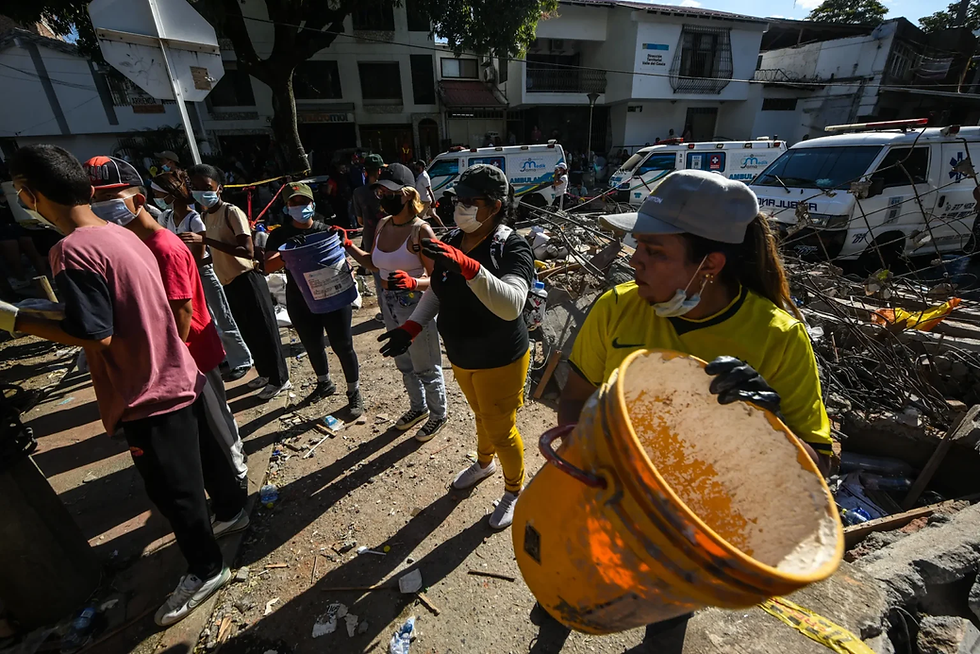
Several women help remove debris following the magnitude 7.4 earthquake, at Carrera 39 and Roosevelt Avenue in Cali, Colombia. Photo: Alejandro Meléndez
Faced with the state’s absence, the true humanitarian response emerged from sectors that have historically been disparaged. The most vulnerable neighborhoods of Cali and Pereira—usually criminalized and stigmatized by official discourse—became the beating heart of survival.
Without asking for anything in return, community kitchens sprang up in working-class neighborhoods. Low-income families set up makeshift stoves on street corners to feed volunteers, distributed water in large containers, obtained essential medical supplies and organized endless human chains to remove tons of debris. Solidarity did not emerge from government offices or affluent neighborhoods, but from the calloused hands of the city’s poor and working class.

Young people learn to cut hair in Chiminangos, Cali, Colombia, following the magnitude 7.4 earthquake. Photo: Alejandro Meléndez

Topos Aztecas prepare their canine team to carry out rescue work at the Cantabria building, at Carrera 45 and Calle 8B in Cali, Colombia, following the magnitude 7.4 earthquake. Photo: Alejandro Meléndez

A young man raises his hands to call for silence at a collapsed building at Carrera 44 and Roosevelt Avenue in Cali, Colombia, following the magnitude 7.4 earthquake. Photo: Alejandro Meléndez
This story was first published by Terra 360.


Comments