
Latinos Swung Left in the Mid-terms, But Sent a Warning to Both Parties
Nov 6, 2026

The celebrations were still underway Nov. 4 as Latino voters began assessing the “blue tsunami” they helped deliver in the 2026 midterm elections.
In Texas, Gina Hinojosa made history as the first Latina elected governor, ending more than three decades of Republican control of the state’s top office. In California, Xavier Becerra became the first Latino elected governor in more than 150 years. Latino candidates also secured a record number of seats in the U.S. House of Representatives.
And in the Rio Grande Valley, where Republicans had made significant inroads among Latino voters in recent elections, Democrats witnessed a dramatic reversal.
Rio Grande Valley is epicenter of ICE activity
”Last night was very emotional,” said Eric Holguin, speaking from Texas’ Rio Grande Valley, at a Nov. 4 briefing organized by UnidosUS. “The Rio Grande Valley has been the epicenter of ICE enforcement. We have seen our neighbors ripped out of our community. People are afraid to stop anywhere between their work and their homes,” said Holguin, the Texas state director for UnidosUS.
In 2024, Texas Governor Greg Abbot issued Executive Order GA-46, which directs Texas hospitals to ask patients about their immigration status. Hospitals are thus largely inaccessible for many immigrants, said Holguin.
“This is a very exciting moment,” said Yadira Sanchez, executive director of Poder Latinx. “Latinos are a swing electorate, and we swing with fuerza, with strength. We don’t need to survive. We need to thrive.” She noted that the results were the fruit of many years of organizing and cultivating the Latino community to become a decisive voting bloc.
‘Need for continuous investment’
“We have seen over the last 2 years a very tough time for Latino families,” said Julián Castro, CEO of the Latino Community Foundation and former mayor of San Antonio. He noted the flailing economy and ICE overreach. “I am pleased that we saw this kind of turnout. Latinos were definitely a part of the decisive story.”
Castro, former Housing and Urban Development secretary in the Obama Administration, said the results underscore the importance of year-round organizing rather than efforts concentrated in the final weeks before an election. “There’s a need for a continuous investment in the community in voter outreach 365 days a year,” he said.

Speakers at the Nov. 4 UnidosUS briefing. (Screenshot)
For UnidosUS President and CEO Janet Murguía, the Latino swing left dispelled the myth that Latino voters are reliably aligned with one political party. “Neither party can afford to ignore or take our vote for granted,” she said.
”We saw a seismic shift. These milestones are especially significant in states were Latinos have significantly contributed to the growing of the US economy,” said Murguia. “This was the largest turnout of Latinos in our nation’s history. We repudiated Trump and sent our anger about the Administration’s policies making our lives worse,” she said.
How did Latinos vote?
A new UnidosUS poll of more than 3,000 Latino voters — conducted by BSP Research — noted that 4 out of 10 Latinos who voted in the 2026 mid-term cast their ballots for the very first time. New voters overwhelmingly favored Democrats, by 69%.
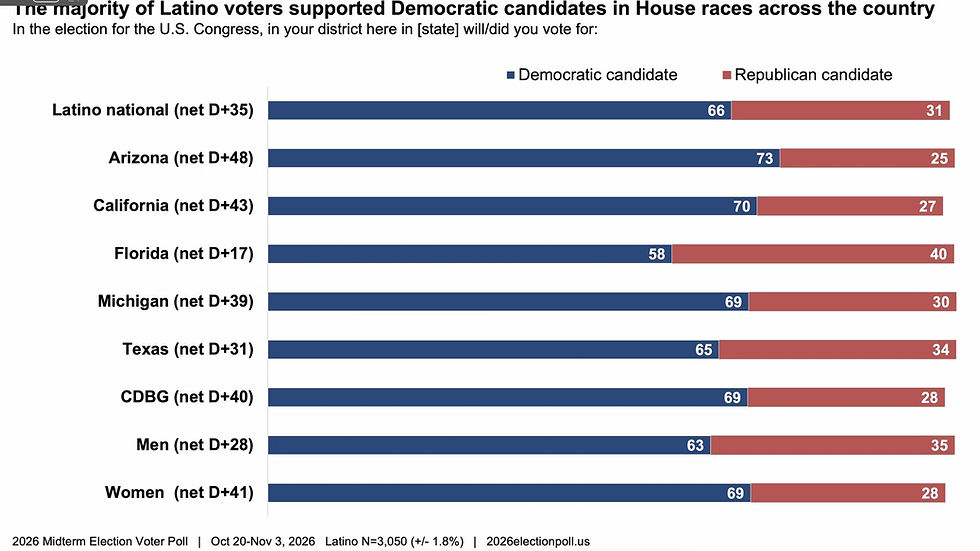
Overall, Latino Democrats improved their performance by 11 percentage points compared with the 2024 Presidential election, in which Kamala Harris topped the ticket. Democratic House candidates held a 35-point advantage among Latino voters nationally.
BSP Research/2026electionpoll.us
The gains were particularly pronounced in Michigan, where Democrats improved by 15 points, and in congressional battleground districts, where the margin shifted 16 points toward Democrats. Florida saw a nine-point improvement. The shift included many people who had voted for President Donald Trump in 2024. Seventeen percent of Latino Trump voters from the previous presidential election crossed over to Democratic candidates in 2026. Only 3% of Harris voters switched to Republicans.
Former Trump voters swing left
In congressional battleground districts, 22% of those who had voted for Trump in 2024 did not repeat their Republican vote.
In the Rio Grande Valley, Democratic Senator-elect James Talarico received 74% of the Latino vote, compared with 24% for his Republican opponent, Ken Paxton. Statewide, his advantage among Latino voters was 65% to 31%. Democrats also made substantial gains in gubernatorial contests. Hinojosa held a 29-point advantage among Latino voters in Texas, while Becerra led by 46 points among Latino voters in California.
The economy was the dominant issue for Latino voters, with cost of living and inflation topping the list of concerns. At the very top of the list was creating a pathway to legal permanent status for undocumented immigrants who have been in the country for a long time.
It’s the economy

Fifty-eight percent identified those issues among their three most important priorities for elected officials, followed by jobs and the economy at 35%, gasoline prices at 30%, housing and healthcare costs at 29% each.
Food and grocery prices were the leading household expense concern, followed by housing, gasoline, utilities and healthcare.
Half of Latino voters said they had little or nothing left after paying their monthly bills, or were struggling financially. Just 15% described themselves as living comfortably.
Trump’s policies have worsened Latino lives
More than 40% expected President Donald Trump’s economic policies to leave them worse off over the coming year, compared with fewer than 20% who anticipated being better off.
“The number one issue is cost of living and inflation,” said Gary Segura, founding partner and president of BSP Research. “The first five positions were all on the cost of living and the ability to survive in the American economy.”
Trump’s overall standing with Latino voters was deeply negative. Sixty-four percent expressed an unfavorable opinion of the president, while 60% viewed congressional Republicans unfavorably.
Voters also disapproved of his handling of inflation and the cost of living by a 45-point net margin, immigration enforcement by 38 points, and the economy and jobs by 32 points.
Sustaining the momentum for 2028
The results may offer an early indication of the political landscape heading into the next presidential election, but they also present a challenge to Democrats who may be tempted to interpret the midterms as a permanent realignment.
Latino voters are not necessarily moving toward one party. They are responding to economic conditions, immigration policies and candidates’ willingness to address their concerns, said Murguia.
The message to the newly elected officials, Castro said, is that historic representation must translate into tangible results. “What are they going to do about affordability? About corruption and rooting that out? Are they going to end ICE’s abuse and cruelty and pursue a more balanced approach on immigration?” he asked.
For Sanchez, the groundwork for 2028 is already being laid. She pointed to young Latino voters, including children of immigrants who became politically engaged amid immigration raids and concerns about their families’ futures.
Young voters
Some young people, she said, were motivated to register and vote specifically to protect their parents.
“We’ve barely seen the beginning,” Sanchez said.
BSP’s Segura noted that the Latino electorate is continually replenished by young people reaching voting age. With a median age of 27, Latinos represent a particularly young constituency, with roughly one million entering the electorate annually as they turn 18.
The challenge for both parties will be to continually engage these new voters, he said.

Comments