
Quien Somos – Part II
- Apr 20
- 6 min read
For Hispanics, Quien Somos is the most important question of our time. It is a question for which political pundits wish they had the answer. To understand the question we must understand what got us here, what we have in common and what makes us different. In defining ourselves we must know one, how we are perceived by the general population and two, how we perceive ourselves. As a Colombiano and Venezolano told me, “Everyone thinks we are Mexicanos”. We Hispanics certainly know who we are. Not too long ago it was easy knowing who we were because we were all Mexicanos.
A Hispanic can come from any part of the Latino World Mexico, Central America, South American and the Caribbean. That is why we call ourselves or others call us Latino. There are very white and very dark skinned Hispanics. Driving around I see Puerto Rican, Cuban, El Salvador, Mexican and the flag of almost every country south of the border. With so much diversity within the Hispanic population it is difficult to celebrate Hispanic Month as the one event that makes unites us all. We May all speak Spanish and most of us may be Catholic, however, regional cultural differences makes bonding difficult.
In this Latino melting pot you have Tejanos, descendants of Spanish Colonial Texas. Tejanos have been part of the Texas landscape for 300 years. Tejanos will tell you how many generations they go back on the fathers’ or mothers’ side. These Tejanos have been fully Americanized. They are part of the White Anglo-Saxon Protestant Culture (WASP) culture through a process called acculturation and assimilation. Next are the children of the Mexican Revolution from about 1910 to 1920. They have been part of the Texas landscape for about 100 years. I am going to use the term Los Primeros Pobladores to describe the first wave of Mexican immigrants. These Mexicanos came and settled and lived where ever they could where ever they could find a place to live and hopefully work. Those that worked for the railroad were fortunate enough to live in boxcars. Others were not as fortunate they lived out of cardboard boxes or some sort of material to place something over their head. Ultimately, the areas where these immigrants settled were called barrios.
Fast forward to today and you will find first, second and third generation descendants of Los Primeros Pobladores. The offspring are third, fourth and fifth generation now fully Americanized part of the White Anglo-Saxon Protestant (WASP) culture. They too will tell you what generation American they are. There is nothing wrong with that, that is exactly the way is supposed to be. This is the process that Italians, Irish, Polish, Czechs, and all minority groups went through as they became a part of the American social landscape. All of these groups retained remnants of their original culture and most celebrate it yearly in local celebrations. You have Saint Patty’s Day, Oktoberfest, to name two. So it is that some descendants of the Primeros Pobladores celebrate Cinco de Mayo and dieciséis de septiembre.
What has separated Mexicanos from other ethnic groups is the continuous infusion of thousands Mexicano immigrants that have rejuvenated and kept alive a vibrant Mexican culture with all its customs and traditions. These immigrants have gradually become acculturated and assimilated into the WASP culture just as the Tejanos and Mexicanos before them. So we understand to be part of this White, Anglo-Saxon Protestant culture, you do not have to be White, you do not have to be Anglo-Saxon and you do not have to be Protestant.
To understand fusion we must understand the historical context of fusion and its relationship to mass migrations. The movement of people can be traced to the second book of the bible, Exodus when Moses took the Jews out of Egypt and to the Promised Land, Israel. Throughout history mass migrations and conquests have dramatically altered the social landscape of a region. For example, it was the Germanic tribes that finally caused the Roman Empire to fall. For centuries there was a slow gradual fusion between what were Romans and the Germanic kingdoms and what emerged is modern Europe. There was a similar fusion between The Tejano and Mexicano. What survived was the Tejano culture. What facilitated this mass migration was an almost wide open border between the United States and Mexico, a border with very few controls. Another example of the impact of a mass migration is the sudden arrival of Cubans to Florida in the early 60’s. Miami and Dade County went from a summer school vacation spot to a dynamic, vibrant economic region.
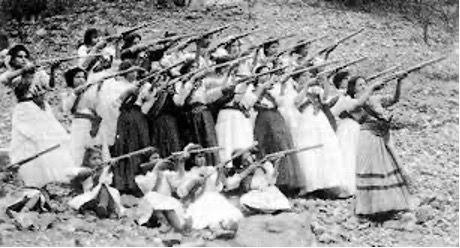
Soldaderas. Wives and Women that accompanied and supported the military. |
The Mexican Revolution was a mass migration. From 1910 to 1920 millions of Mexicans trekked north to the United States to escape the turmoil of a brutal revolution, an oppressive regime and dire economic circumstances. The movement did not end in 1920, it continued although in smaller numbers.
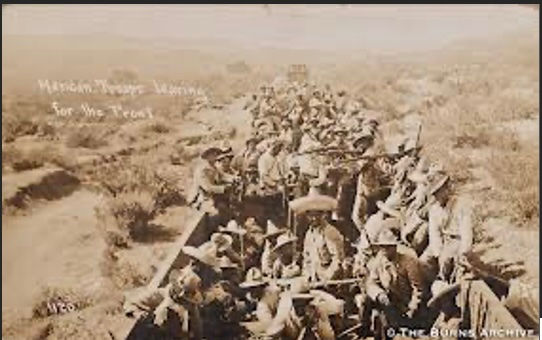
Mexican troops on their way to the front lines. |
These Mexicans scattered throughout the United States. Some came alone others brought their whole family. This migration was no different than the one that occurred in the early 1800’s when thousands of Americans and Europeans trekked into Texas in search of land. For the second time in their history the Tejano was overwhelmed by a new people seeking a new home. First it was the Americano, this time it was the Mexicano. Unlike the Americano, the Mexicano was not looking for land or power he was looking for political and economic opportunity something he did not have in Mexico.
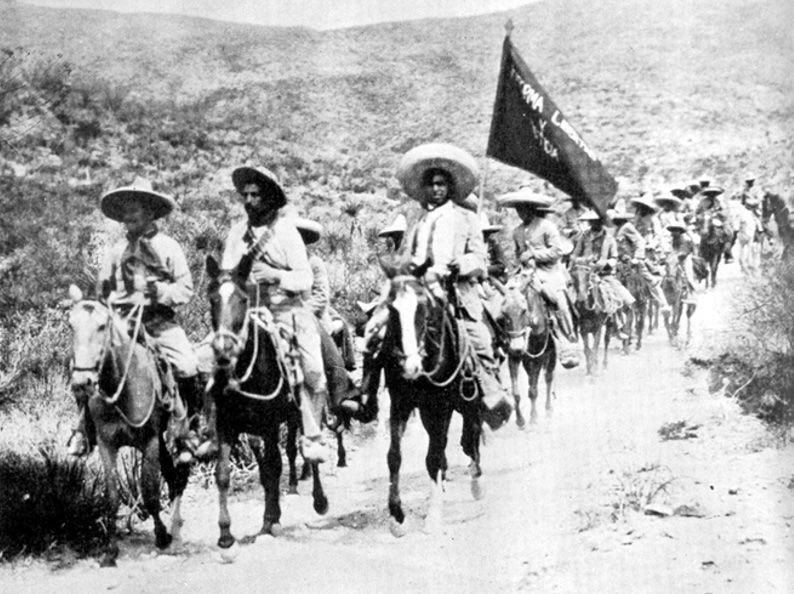
Rebeldes. |
The second mass migration occurred in the 70’s and 80’s when because of war and famine hundreds of thousands of Central American’s risked their life traveling to the United States. Many came in a train called “el tren de la muerte”. Not all took the train ride. I asked a gentleman in a nursing how he had gotten here from Central America and he replied “I walked”. The journey of the Centro Americano was much more treacherous than that of the Mexicano because the US had a wide open border with Mexico for many years. Before 1903 there were no controls along the southern US border to enter the US. After 1903 all you had to do was fill out a card, stating where you were going. The route of the Centro Americano was much different. The Centro Americano had to cross Mexico from the southern border to its northern border with the United States.
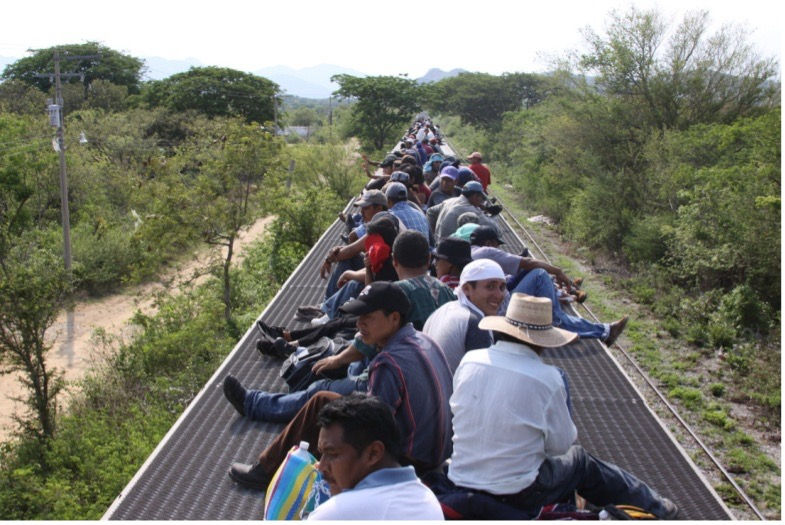
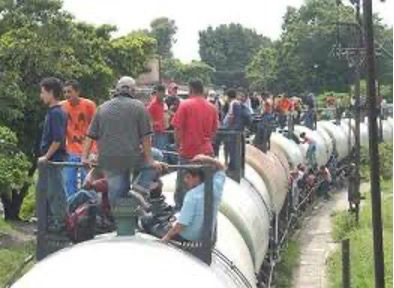
La Bestia or El Tren de La Muerte. Centro Americanos on their long journey to America. |
Today in Texas we the Tejano, Mexicano and the Centro Americano in the Hispanic salad bowl. We are of vastly different social, political and economic backgrounds under one label, Hispanic with the hope of someday being called an “Americano”.
Hispanics have developed over a period of time. Perhaps some multigenerational Mexicano, now an Americano, is resentful of a recent immigrant that looks at him with disdain because he cannot speak Spanish and does not like to be called “Mexicano”. Mexicanos are still more than sixty percent of the Hispanic world there should be some light friction between the dominant Mexicano and a Centro Americano. This friction can also be seen in school with different Hispanics jabbing each other over their national origin. Mexicanos and Centro Americanos who are born here and have been educated here have mostly lost their cultural identity and identify themselves more and Hispanic or American.
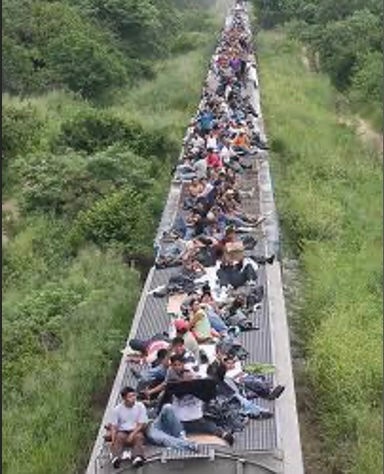
Top View of the Tren de la Muerte. |
Those that have not traveled this road to America do not know what it is like. The history of how we Hispanics got here is certainly different. The Centro Americano has no connection to what the Tejano and Mexicano endured while becoming Americanized. Whether it was the Texas Revolution, the Mexican Revolution or the Tren de la Muerte these three events cannot be connected with the simple term Hispanic. The hardship endured by the three groups on their way to becoming Americano was vastly different.
The arrival of hundreds of thousands Centro Americanos has altered the social fabric of the Tejano/Mexicano in Texas. The infusion of recent Mexicano immigrants coupled with the infusion of hundreds of thousands of Centro Americanos created a hybrid culture no longer of just Tejano/Mexicano roots. What you have now is a fusion between the Tejano/Mexicano and the Centro Americano. For the foreseeable future you will have a bicultural State of Texas. You will have WASP and Tejano/Mexican/Centro Americano (Hispanic) cultures existing side by side. In someone else’s lifetime you will have a WASP/Hispanic/African American/Asian culture. The Census Bureau will coin a name for the new breed of American.
Deportations are not new either. The Romans tried to rid themselves of the Germanic tribes but they failed. So it was that in the 30’s the United States deported hundreds of thousands of Mexicans, some of American birth, back to Mexico. The Obama administration has deported more Hispanics than any other president. Yet Hispanics voted him into office. It seems like an anomaly yet it is not. There are many first generation Hispanics of Mexican and Central American descent with a motivation to vote since some of their relatives may actually be illegal immigrants. These first generation Americans bear witness to many relatives who have been deported. These Hispanics now account for a large percentage of the Hispanic population. They are a powerful voting bloc to be reckoned with.
Felix Alvarado
Part III – Mexican Fort Worth


Comments